How Things Have Changed for Girls in the Past 50 Years
Sometimes, I look back and realize just how many quiet revolutions I’ve lived through. They weren’t the kind that make headlines, but the kind that change how ordinary people live, dress, and think. When I think back to how things were 50-60 years ago for girls in school, I am surprised by how many things we took for granted as just being ‘the way things were’ and never even realized we were a part of a cultural revolution.


I remember in the 1960s when girls could only wear skirts or dresses to school. Around 1970, girls were finally allowed to wear pants, but only if they were part of a “pantsuit.” In the mid-1970s, girls could finally wear jeans (or “dungarees,” as the teachers called them, but there were strict rules. They couldn’t be faded, torn, patched, or rolled at the cuffs. They also had to be in a “girls’ style,” meaning they were cut more like dress pants made from denim. “Girls’ Style Jeans” really looked more like dress pants made out of denim than what we now call ‘jeans.’


Even gym class was different for girls. It wasn’t called PE back then. Boys’ and girls’ gym classes were separate until the late 1970s. Girls had to wear one-piece gym suits that zipped up and had darts in the front so we would look “ladylike,” while boys wore shorts and T-shirts. Even our gym shoes were regulated. We had to wear “girls’ gym shoes,” thin white or blue canvas sneakers with almost no support. When schools finally allowed us to wear the sturdier “boys’ gym shoes,” those delicate versions disappeared almost overnight.


About the only time junior high and high school age students were in gym together was for the infamous square-dancing classes we had to take. We had our first square-dancing class in fourth grade, and eighth grade was the last year we were forced to do this. Sometimes, there were more girls than boys, so girls would have to partner with another girl. It was a strict, but unwritten rule, that two girls could dance together, but two boys never could.

Until I was in ninth grade, we had separate gyms for boys and girls. I never saw the boys’ gym until ninth grade, when classes became co-ed. Even then, the difference was obvious. The boys’ gym was large, with a full basketball court, polished hardwood floors, bold court lines, and bleachers on both sides. The girls’ gym was only a half-court with a composite floor and faint paint lines. The basketball nets were lower and usually cranked up out of the way. The ceilings were so low that when we practiced layups, the ball sometimes got stuck in the beams.


Half the Court, Half the Freedom
Even what we learned in gym class was different. Girls had to play “girls’ basketball,” a version created to make the game “easier,” since it was believed that full-court basketball was too demanding for girls. This old version, used in many schools from the early 1900s through the 1970s, was called “six-on-six” or “girls’ rules basketball.”

When I first played basketball in school, it wasn’t the same game the boys played. We had six players instead of five—three forwards who could shoot and three guards who stayed on the defensive side. We played on a half-court divided by a center line that only the players handling the ball could cross . We could dribble only three times before passing, and physical contact was almost completely forbidden. We were even allowed, and encouraged, to shoot baskets “granny-style,” holding the ball between our knees and tossing it underhand toward the hoop. The pace was slow, the scores were low, and the message was clear: girls were expected to stay in their place, both on the court and off it.

Even our uniforms told the story. Those stiff, unflattering one-piece gym suits were designed to look proper rather than practical. Looking back, I can see how those “rules” mirrored the larger social expectations for girls at the time. Our sports and our clothing were built around the belief that girls were fragile and needed protection from anything too vigorous. It seems absurd now, but it shaped generations of girls’ experiences in school.
The Art of Gym Class: Grace Over Grit


Back then, even gym class reflected what adults thought girls should be. We didn’t play basketball often. While the boys learned wrestling, indoor hockey, and rope climbing, we were guided toward something called “educational gymnastics poses.” The teacher would hold up posters showing silhouettes of girls forming shapes—arches, pyramids, balances, or mirror poses—and we had to recreate them in pairs or trios. Mostly, this was geared for getting girls ready for the major ‘girl sport’ of the era, which was cheerleading. It wasn’t about strength or competition; it was about grace, rhythm, and teamwork. Sometimes we moved to music, sometimes in silence, always carefully, neatly, and “ladylike.”


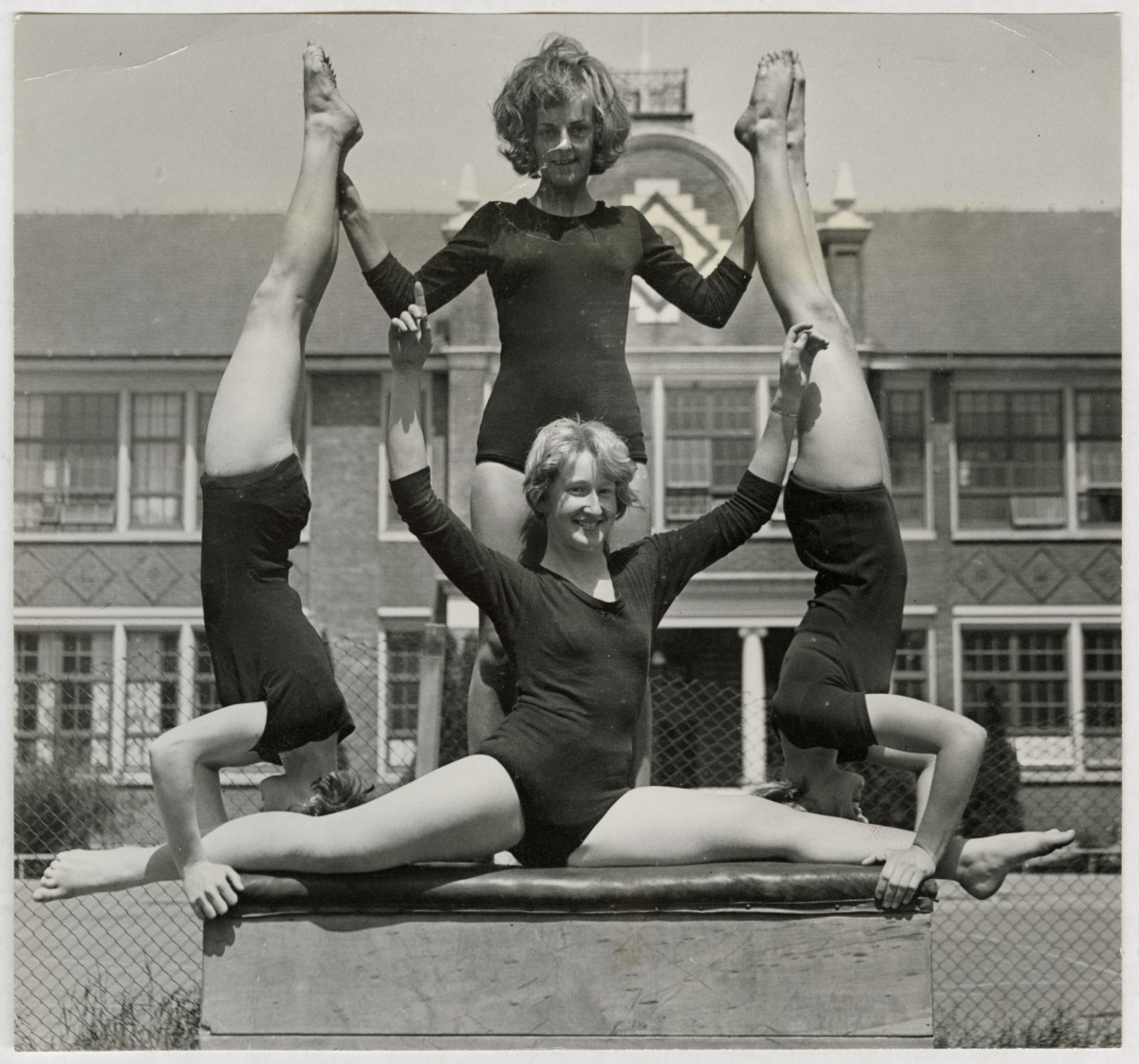
At the time, it seemed normal. Only later did I realize how those lessons shaped what we thought we could do. The boys built muscle and confidence in their own strength. We learned to move beautifully within limits someone else had drawn for us, always reminded to be graceful above all else.
Running Against Limits
Track and field for girls in the 1960s was another story of boundaries. We weren’t encouraged to test our limits; we were told we had them. The longest race most schools allowed was the 400 meters, and even that was considered daring. Anything longer was thought to be “too hard on the female body.” There were no pole vaults, no steeplechase, and certainly no marathon dreams for girls. Our shoes were thin canvas, our uniforms were culottes or those same one-piece gym suits, and our races were short and polite. While the boys trained to push themselves, we were trained to stay within the lines drawn for our “protection.”
Separate and Unequal: Access, Uniforms, and Coaching
Looking back, it’s impossible to miss how uneven school sports were. The boys had full teams for every season—varsity, junior varsity, and sometimes even freshman squads. They had real coaches, matching numbered uniforms, and the best gym times and equipment. Their sports were loud, physical, and proudly competitive.
For the girls, it was another story. Cheerleading was the big opportunity, with its polished uniforms, pom-poms, and choreographed enthusiasm, but it mostly existed to cheer for the boys. When girls’ sports teams did form, they struggled to find enough players and often didn’t have proper uniforms. We wore our gym suits or athletic shorts, and practice usually meant borrowing a corner of the boys’ gym after they finished.


Other popular sports activities for girls were baton twirling, tennis, badminton, and volleyball.


Coaches for girls were almost always volunteers. The boys’ coaches were paid stipends for their work. Bus transportation was provided for the boys’ teams; the girls’ teams carpooled to events. The results of the boys’ games appeared in the local sports section of the newspaper. The girls’ teams were mentioned only if they won a regional event or as a novelty story about “the girls’ efforts.”

At the time, it all felt normal. Only later did I realize that what we lacked wasn’t talent or interest—it was opportunity. The difference between what boys were given and what girls were offered wasn’t about ability. It was about expectations.
Today’s girls can hardly imagine those days. Just as we once struggled to picture what our great-grandmothers endured as suffragists fighting for the right to vote, the young women of today can’t fully imagine a time when girls were expected to be “ladylike” at all times, even in gym class. I’m grateful they don’t have to. The world I grew up in is now history, and those quiet revolutions such as pants in classrooms, sneakers with support, and girls running their own races, were steps toward something better.
We never realized we were part of a cultural revolution. It seemed to happen so gradually, but it didn’t happen without effort and pushing the limits of what was acceptable during that time frame.

